

Since the world is celebrating Mother's Day today, I looked it up on Google where it comes from. Anna Jarvis wanted to commemorate the death of her mother Anna Reeves Jarvis, who cared for soldiers on both sides during the American Civil War. So it fits very well into the present time in which we live.
Climate disasters, forced migration, pandemics... The list of self-made crises is quite long. Most of these problems are caused by the violence that underlies the way we produce and consume. By violence, I mean the destruction of virgin forests, the dumping of plastic waste, and the exploitation of vulnerable workers in anonymous and brutal supply chains. The combination of toxic masculinity, greed and power is driving us to ruin.
- We need a more feminine way of living. I don't just mean women-led businesses and organizations. I mean a more maternal way of doing things.
- More love and less destruction . In this cold and dark universe, this small planet is our only home. A more life-friendly and natural way of doing things than endless automation and the employment of ever-increasing numbers of robots.
- More natural and fewer synthetic ingredients . It may have a shorter lifespan and not always look perfect, but one less chemical in our bodies and in the environment is also one less problem for the world.
- More beauty and less mass production. Away from fast fashion, towards something that will still look beautiful in 10 or 20 years. Less driven by market trends and more by the creativity of artisans. Less uniformity and more unique products that give more freedom to both the creator and the consumer.
- More mindfulness and less indifference. A more conscious and mindful approach to consumption. Consume less, but enjoy more. Celebrate self-care with beautiful products that are produced without harming nature and people. Mutual respect between manufacturer and consumer instead of anonymous supply chains.
With all these principles in mind, we developed our violence-free, handwoven silk scarves.
We use Tussar silk, which is made from the larvae of silkworms that live on the mulberry tree. Once the caterpillar has spun its cocoon, they are collected from the trees and left in the sunlight until the silkworm transforms into a butterfly.

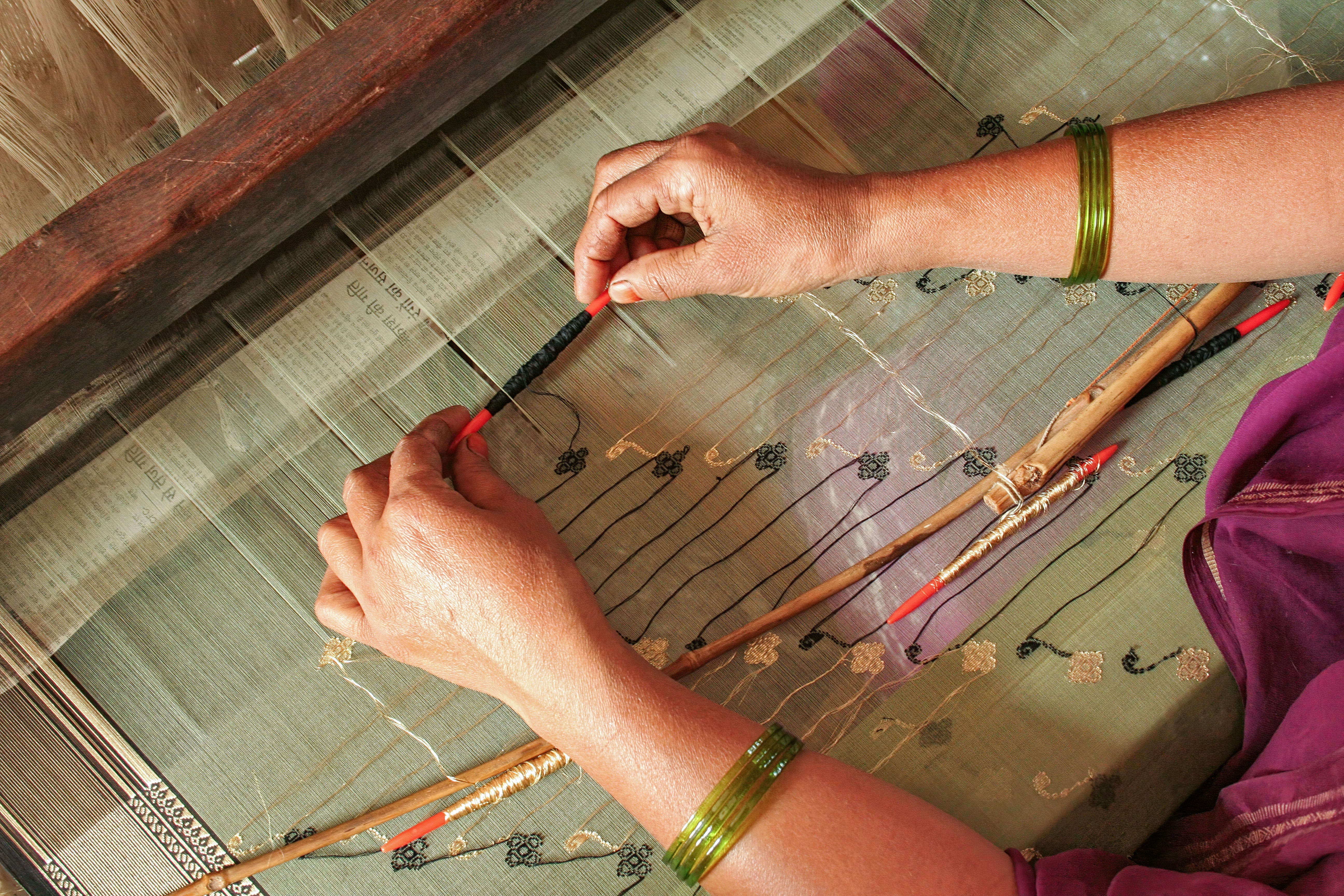
The silk thread is then handwoven into fine silk scarves by a women's collective in the village of Champa in Chattisgarh, India. A group of about 40 women work together in a small handloom workshop just a few hundred meters from their homes. They work whenever they have time and have a key to the facility so they can come and go as they please. Each scarf is 2.2m x 0.6m and it takes about half a day to weave one. Artisans like Saraswati Bai use their creative freedom to make small changes to each piece, making each scarf unique.
The ends are then tied by hand before being dyed. Some scarves are hand-painted using natural dyes such as turmeric or indigo. All in all, each piece takes between 9 and 12 hours to make. We do not use machines or electricity, as the handloom is powered by hand and feet.
The scarves are packed in compostable bags made of potato starch. We compensate for the CO2 generated by transport to Germany and use DHL GoGreen for shipping within Europe. We produce in small batches so that we can ensure quality while remaining true to our principles . Growth is not an end in itself. We would rather not grow than lose focus on our values.

Saraswati Bai, one of the best weavers in the group
15% of the sales proceeds go into a pot that takes care of the health of women and the education of their children. Since we are still at the very beginning, we want to sell our initial stock first and then establish measures such as health insurance for the women who work there or school support for the children and much more.
So today, Mother’s Day, marks the beginning of a new chapter at āsmi and I hope we can make a small difference for a small group of women .
Leave a comment